
PRODUCING SUPERHARD MATERIALS BY MODIFYING ULTRADISPERSED TUNGSTEN CARBIDE ALLOYS WITH BORON CONTAINING QUASIEUTETIC
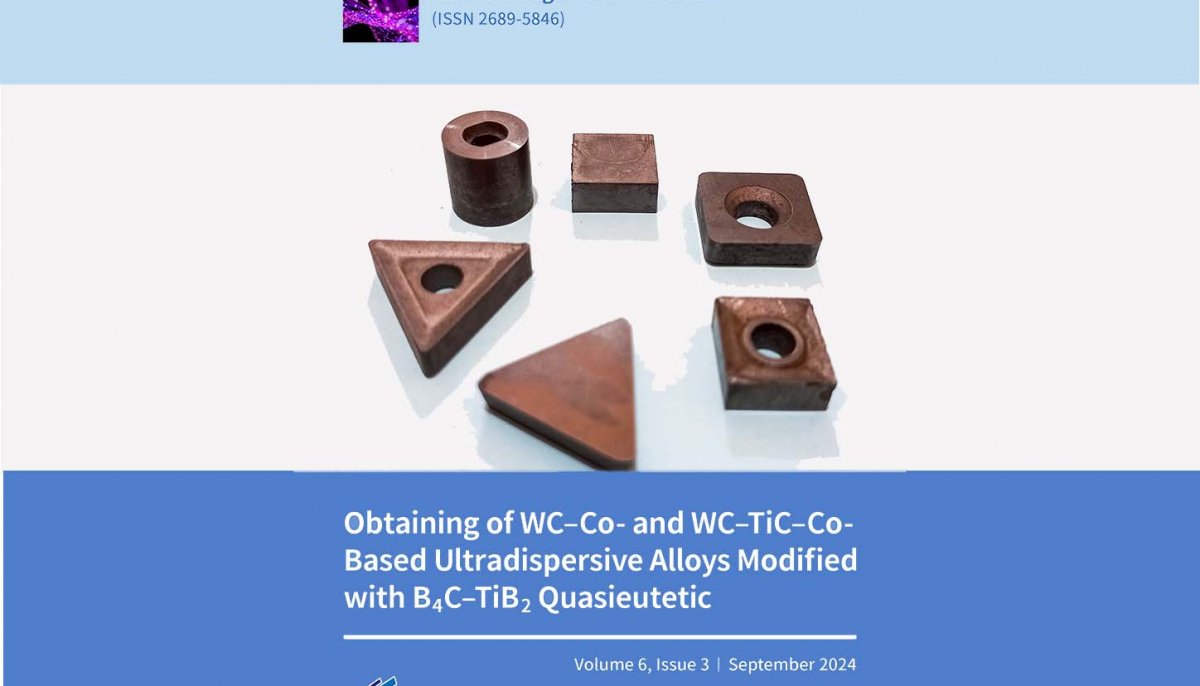
Tungsten carbide (WC) based materials, characterized by high hardness and wear resistance, have long been widely used in the production of cutting and mining tools. To further improve functional performance, they are alloyed or modified with various ceramic phases. A team of researchers from the Ferdinand Tavadze Metallurgy and Materials Science Institute (MMI) obtained ultradispersed powders of hard metalceramic alloys—tungsten carbide–cobalt (WC–Co) and tungsten carbide–titanium carbide–cobalt (WC–TiC–Co)—modified with a quasieutectic ceramic alloy—boron carbide–titanium diboride (B4C–TiB2), as well as their compacts of complex shapes. The advantages of this modifier are: (1) Hardness almost as high as that of pure boron carbide and (2) Electrical and thermal conductivity several orders of magnitude higher, enabling rapid compaction while preventing a decrease in dispersion.
The results of this study were comprehensively (over 50 pages) summarized in a paper by Otar Tsagareishvili, Archil Mikeladze, Roin Chedia, Tamaz Batsikadze, and Levan Chkhartishvili, published in the journal “Recent Progress in Materials”:
- O. Tsagareishvili, A. Mikeladze, R. Chedia, T. Batsikadze, L. Chkhartishvili. Obtaining of WC–Co- and WC–TiC–Co-Based Ultradispersive Alloys Modified with B4C–TiB2 Quasieutetic. Rec. Prog. Mater., 2024, 6 (3), 21 (1-50).
https://doi.org/10.21926/rpm.2403021
Paper _ Rec. Prog. Mater. 2024 6 (3) 21 (1-50).pdf
The LIDSEN Publishing Inc. (USA) considered this paper as the leading one of the corresponding issue of the journal and published its title and a photo of the tools made using the method developed therein on the cover of the issue. This fact should be considered as one more confirmation of the international recognition of the importance, relevance, and effectiveness of the scientific research work carried out at the MMI.